Those who have visited Goa at least once in their lifetime will vouch for the beguiling beauty of the Portuguese influenced architecture.
Houses built with red bricks of laterite stone with sloping tiled roofs and an elevated front step (colloquially called ‘Balcao’) are a typical sight here.
However, my first post of the #BlogchatterA2Z series, is about an aspect of Goa’s architecture that is not glaringly obvious and often underrated, a feature of Goan heritage you may not know much about, especially if you are a visiting tourist.
So for the uninitiated, let me tell you a little about Azulejos.

What are Azulejos?
Azulejos are ceramic tiles that are hand painted and glazed. In Spanish, Azulejos mean ‘polished stone’ and that is what these essentially are.

History:
If you dig deep to find their roots, Azulejos have quite a travelling heritage, tracing back to 15th century Arabia. Apparently, they then traveled to Seville in Spain, and later in the 16th century to Portugal, who introduced them to Goa.
However, with Goa’s liberation in 1961, the popularity of Azulejos died down. Until much later, cut to 1998, when a young Goan Orlando Norhona, went to Lisbon to study music and literature, and through a serendipitous twist of fate, met a man who introduced him to Azulejos. Orlando was so fascinated with what he saw, that he learned the technique of creating Azulejos. He returned to Goa with a bag full of tiles and a mission…to revive Azulejo art in Goa.
You can check his interview here.
Motifs:

Today, in Goa, you will find available Azulejos of different sizes and shapes, painted with a multitude of colours.
However, if you look carefully, you will still discover the traditional blue and white pattern of Azulejos in old churches and places of historical importance.
Popular motifs include remnants of a slowly disappearing culture…toddy tappers, fishermen, boats, ferries, taverns etc,
Goan churches and temples are another common theme. Decorative panels and inlay designs have ethnic themes like religious symbols, peacock, lotus, flowers etc.
Themes from the Bible can also be seen depicted…eg in the famous St Anthony’s Church.
Seen at:
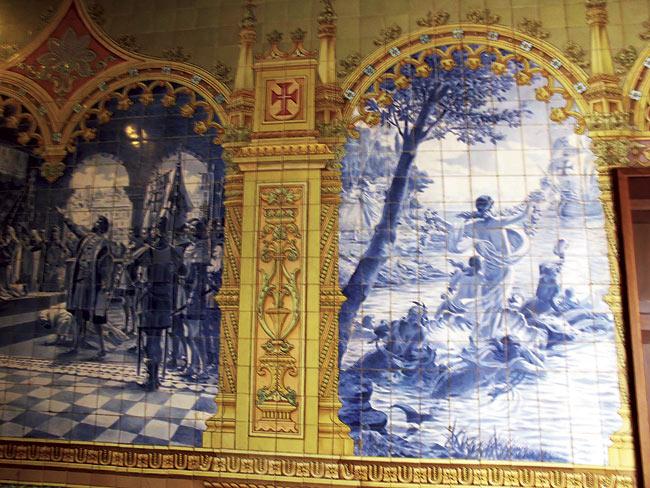
Azulejos are a common sight decorating walls of hotels, railway stations, cafes, guest houses, and even traditional Catholic homes and buildings. They are used to create wall murals, decorative panels, and name plates.
A few glorious examples are found at:
1) Menezes Braganza in Panjim - where there are magnificent 200 sq feet murals painted by Jorge Colaco of Vasco Da Gama’s sea route to Goa in 1948.
2) Azulejos stores like Velha Goa , Goa ceramics, Orlando Noronha’s Galeria Azulejos De Goa etc.
3) Condolim Church
4) Pilar reconciliation chapel
5) Bishops house
6) Orlando De Noronha’s gallery has a Mario Miranda collection in which he replicates Mario Miranda’s famous art characters on Azulejos.
Purpose:
1) Major feature of Goa’s architectural scene.
2) Azulejos serve as good souvenir for tourists visiting Goa who want to take back home a slice of Goan heritage, it’s art and culture (commonly picked up are Azulejos with Mario Miranda caricatures—a tribute to the Goan artist).
3) Azulejos are now used to decorate not just walls and create murals but also employed nowadays to make photo frames, jewellery, and exquisite pieces of crockery.
However, nothing can take away from the fact that Azulejos were, are, and will hopefully always be a part of Goan culture and heritage.
You may see these glazed tiles only for its ornamental value, as a mere souvenir or gift item.
But only a true Goan will know that Azulejos are much more than that.
A testimony to the past. A legacy that deserves to be preserved and cherished. A story that needs to be regaled for generations to come.
A story of who we are. A story of our roots.
And for all that Goa has endured, witnessed, and cherished over the ages, we have but one thing to say, ‘Obrigado, Goa!’
If you are interested in knowing a little more about Goan life and culture, come back tomorrow to read about yet another riveting representation of our heritage.
Until then, like we Goans say,
Mog aasu di.
(Let there be love!)
————————
I’m participating in #BlogchatterA2Z.
My theme for the challenge is ‘Obrigado, Goa!’, under which I’ll be writing 26 posts on Goa (April 1-30th, excluding Sundays), each post corresponding to the letters of the English alphabet. You can read more about it in my theme reveal post.