March 11, 2022

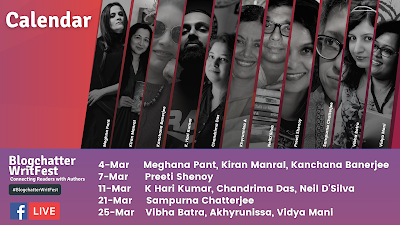
#BlogchatterWritFest: Season 6 Session 2: A writing class with Preeti Shenoy

When Blogchatterrevealed the author for the second session of the #BlogchatterWritFestival, I knew I had to attend it.

Preeti Shenoy was amongst the first people whose blog I used to frequent. From then to now, her journey has been an awe-inspiring one. 
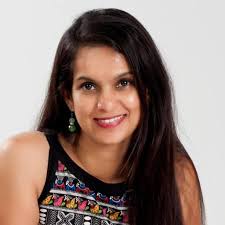

For those living under a rock, Preeti Shenoy is among the highest selling Indian authors. Her name is in the Forbes long list of most influential Indian celebrities. Motivational speaker, fitness enthusiast, and portraiture artist are some other titles she has in her kitty.

But more than all this, Preeti to me is a woman of substance and style. She knows how to captivate her audience with her pleasant disposition and her words. And what stands out is her amazing modesty and lively nature, a trait I have always appreciated in people.

Having read some of her books (right from '34 bubblegums and candy' to her latest ‘Love a little stronger’,  I could be certain this special workshop on ‘how to write engaging stories’ would have some valuable gems in store. 

And true to its word, it did deliver what it claimed. 

The session started with Blogchatter host Geethica giving a brief introduction on Preeti and her work. She then proceeded to ask her some pertinent questions per-submitted by the members. Preeti fielded each question with the expected finesse of a person who knows her craft. 

Here is a brief overview/recap of the workshop and my thoughts on it:

When asked how we can make the stories we write engaging, she offered some great advice like engaging the reader with writing hooks, preferably at the start and end of the story. 

I’ve come across stories that start with a bang and end with a whimper and I often fear my story may not be able to hold the readers attention to the very end. So inserting writing hooks was some great advice and a great reminder.

On the topic of starting points for short and long stories, Preeti emphasised that there is no particular rule. You can start at whatever point in the story. But for short stories, starting the narrative with the protagonist in action is always preferred. Get straight to the point. 

On creating relatable characters for your fiction, she suggested listing out his/her physical attributes, behavioural traits, everything up to the last detail, separately before starting off. That way, even if you don’t mention all the character traits, you know exactly how your characters will act in a particular situation. She also advised on creating real characters with real problems. 

Geethica then put forth another question: How much emotion do we pour Ina story? To that Preeti spoke about making the reader care about the character in your story, something i couldn’t agree more upon. We often label a book as a favourite only if it has moved us in some way. 

Preeti’s answer to how much reality she adds in her fiction was a refreshingly innovative one. While I’ve heard most best selling authors talk about incorporating a slice of life in their books, I have often wondered what truly interesting lives they must lead. Preeti, however, surprised me by saying, ‘Your Imagination is the biggest weapon in your arsenal.”  Now, doesn’t that answer wash away your guilt of living a perfectly ordinary life and open an entire gamut of new possibilities instead? What more can a writer wish for? 

On how to fight writers block, Preeti enumerated some easy-peasy techniques like trying to write like you are describing something (eg a room) to a blind man. If you are stuck in the middle of a WIP, she suggested you retrace and read it all over again…from page 1. That makes identifying and removing the ‘block’ in the story.

Other questions that Geethica asked included how to maintain the flow in the story, how to go beyond the personal narrative, how and where to add conflict etc. Preeti answered those by speaking about different methods like revising your plot every time you sit to write for a smoother flow, doing enough research, mapping the story line etc. 

The session was then open for questions by attendees. Here, Preeti offered helpful tips like balancing the right amount of dialogue and narrative. She suggested taking up creative writing courses that are extremely beneficial, especially in this regard. She also encouraged having the story read by an extra pair of eyes (preferably 2-3 people who read across different genres) and taking their opinion before submitting it. 

To sum up, the session was an extremely engaging and helpful one with important nuggets of information for all writers and not a dull moment. 

Thanks to Blogchatter for arranging this wonderful rendezvous with Preeti Shenoy for their I’m already looking forward to Session 3. 

Until then. cheers! 

-------------------------------------------------------------------

Written as part of BlogchatterWritFest.
March 07, 2022

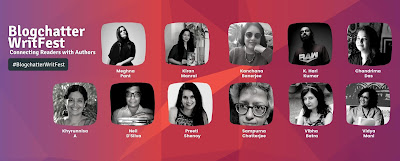
#BlogchatterWritFest: Season 6, session 1: 'Relatability in fiction' (an overview)

When I first heard the topic for the first session at the #BlogchatterWritFest this year,  I was chuffed. 

Being an avid reader and writer myself, I often wonder where to tow the line between make believe and reality. How much of realism do we add to our stories? And if we do add a fair amount, then is it fair to call it fiction? Are all novels semi-autobiographical? 

With my head brimming with all these questions, I logged in onto Facebook live on March 4th at 7pm to attend the first session of Season 6, titled 'Relatability in fiction. 

The panelists included three eminent writers of Indian fiction:

Kanchana Bannerjee, author of 3 books and has been a freelance writer for leading publications and reputed MNCs.

Kiran Manral, a writer, author, and novelist who has several published books to her credit. 

And last but not least, Meghna Pant an award winning and best selling author, screenwriter, journalist and speaker. 

The event started on time with a quick introduction from Harshita of the Blogchatter team who was hosting the event. She was accompanied by Meghna and Kanchana from their respective homes. Kiran was running late. 

Opening question: How can a author make a book focus on a social issue without sounding too preachy?

Meghna answered by speaking about her book that deals with a pertinent issue, 'Boys don't cry;. In today's society, where feminism almost always has a negative connotation, Meghna Pant tried bust the myth saying, "We women are neither bechaari nor krantikaari. Most of us are just normal naaris."

She also revealed that she, as a writer, uses comedy as a lens to make social issues accessible and to cut across mindsets and stereotypes. And that’s how she makes it relatable. 

Takeaway 1: Create balanced characters, especially women characters, because that is what women really are. 

The next question was directed towards Kanchana and was on how to avoid purple prose when it comes to writing fiction.

Kanchana answered by saying that one has to be extremely clear on what one is writing and then exercise some degree of restraint. On the topic of social commentary in fiction, she spoke about how it will inadvertently slip into everything you write, as authors too are part of the society and these things are unavoidable. 

Takeaway 2: Pre-decide your plot as much as possible. At one point, the plot/characters will surprise you by taking things in their hand. 

On the topic of trends and how they influence the writing of authors, Meghna elaborated on how the story you write should eventually outlive you as the author and the trend. 

She spoke about a time when she was asked to take up an androgynous pseudonym for the sales to improve. But she had declined (and look how far she has come) and stood her ground. She encourages writers to do the same—-listen to your instincts.

Kanchana, on the topic, suggested that it’s all about enjoying the process and not settling for anything less than thorough. 

Both agreed that writers should believe in themselves,even at the risk of seeming arrogant at times. 

I particularly liked the way Meghna wove in a bit of poetry, quoting Frost, to suggest that it’s usually the road less traveled that leads you to your actual journey. 

However, both writers gave one advice in common--never to give up a steady source of income as writing full time hardly brings in any money. So if earning is your aim, you may have to give a writing career a second thought. 

Takeaway 3: Have a backup career you can rely on or be prepared for a lot of hustle. 

On the topic of writing rituals, all three authors (by that time Kiran Manral who was running late had joined in) practiced the same routine, reminding me of Virginia Woolf’s ‘A room of my own’. Each of them said that all they needed to write was complete isolation in their respective rooms and the story idea in their head. 

Takeaway 4: You don't need fancy locations or plush surroundings for inspiration. When you have an idea, you only need a little quiet to work on it. 

When asked if there was a difference in the way they approach fiction and nonfiction, Kiran (being a writer of both) succinctly fielded the question by saying that fiction should be plausible and that it’s a paradox how fiction should be made as factual as possible. 

Takeaway 5: Larger than life characters are never relatable. 

The authors also shared their favourite books, most of which connected me with them immediately (as they are my favourite books too). Off the top of my head,  3 men in a boat, Gone girl, Gone with the wind, Little women were mentioned. 

When it came to the Q&A session, of my questions was picked up. I wanted to know what each writer would prefer: a relatable but relatively common story line or an innovative but bordering-on-absurdist plot? 

To which Meghna elaborated on how she’d prefer realistic and relatable and Kanchana explained how it was more about creating compelling characters and settings in order to keep the reader hooked. 

When asked what they decide on first, the story or the genra, all three agreed it was the story. 

Kiran whose wonky internet connection had resumed by then perfectly concluded the session by saying, ‘it’s the story that chooses you. ‘

To sum up, it was a wonderful session with lots to take home from. 

I have always believed we learn best from our own experiences and from the experiences of others who have treaded similar paths. And BlogchatterWritFest, in a wonderful little way, makes both these things possible. 

I look forward to the sessions ahead. 


Written as part of BlogchatterWritFest

February 01, 2022

On the topic of

What is poetry, really? And where do we find it? 

Poetry, like water,  sometimes trickles down our eyes and blots itself into fragrant words on paper. 

Other times, it flits from the corners of our mouth like a kiss that is blown to our beloved, flying across smiling lips, ours to theirs. 

Poetry can create ripples of emotion. It can arouse waves of desire. It can form whirlpools of despair, drowning us bit by bit into the invisible depth of the ocean in our heart. 

Poetry is a tempest but it is also the lighthouse that saves us from the storm.  

It can kill us with its intensity but also revitalize us with hope.


Poetry is everywhere…in the soft tinkle of a child’s laughter, in the unbearable silence after a lovers tiff, in the beauty of changing seasons, in the pain of heartbreak, in the kindness of strangers, in the delicate arrangement of whorls of flower petals, in the colors of the rainbow, in the surreal  spectrum of the prism formed by a drop of dew on a tree leaf. Just like the fibonacci sequence is evident in nature, poetry too is all around us. 

And for that we must be grateful.

January 31, 2022

Madame Oviri

Why do you brood, O’ feral child

You are but a Goddess of the wild 

With flowing tresses flying loose

Beckoning the wind to a whirling cruise   

Your open wide iridescent eyes 

Challenge the clear luminescent skies

Death and melancholy, your things of play 

Untamed, always willing to slay

Why do you mourn, why do you weep

Your courage is mighty, your passion deep

O’ mistress of beasts, mother of wolves

You clutch at your cubs while they snooze

It’s tough to grasp your smothering love

Indifferent outside, no sign above 

A ‘civilised savage’ you claim to be  

Immortalised as Gauguin’s 'Oviri'

© Priyanka Naik 

Pic source: Wikipedia.


Author’s note: The title gets its name from the 1894 ceramic sculpture by French artist, Paul Gauguin. 

My poem which is inspired by the same  is a rendition to the ‘feral’ side of the Goddess in every woman.

January 20, 2022

#ECommerceBuildsEconomy : Shopping in pyjamas

 A week ago, I wanted to buy some art supplies. It was 10.00 pm when I remembered. It had been a long day. However, that did not stop me. All I had to do is flip open my phone, go to Amazon, and voila. Within minutes, the job was done. I quickly browsed through a few pages of options, made my choice, and ordered what I needed. 

For someone like me who usually goes the entire day twiddling her thumbs only to remember urgent shopping errands at odd hours in the night or wee hours in the morning, online shopping has indeed been a boon. 

And that got me thinking how much e-commerce has revolutionised our shopping today. Imagine a similar situation some years ago before the advent of the Internet. 

I’d have to wait until the next morning, probably knotting my handkerchief a few times to serve as a reminder, which of course would again inadvertently be drowned out in the numerous errands that spring throughout the day. And even when I did eventually remember by late evening and dragged my tired self out of my home, I’d have to scourge a few dozen shops to get the things I needed. Yeah, I’m also picky like that. 

Cut to present day , I can literally have everything delivered to my doorstep and all it takes is a few clicks. 

That, my friends, is the magic of e-commerce! 


A lot of people I know, however, still do not avail of the online shopping option. They’d rather prefer going to the local store and making their purchases. Their trust issue is mainly regarding the credit card details that needs to be entered while making an online purchase. Well, what can be said? There is always the ‘Cash On Delivery’ option for those nervous about the chances of phishing. 

If, however, one is careful in choosing trusted and reliable platforms (read Dr Roshan’s post here), then online shopping can be a breeze.


Here are a few advantages that makes e-commerce beneficial for our economy and also for the common man, the consumer.

  1. Easy accessibility and availability: Since the Internet is a global medium, e-commerce websites are available world wide and are widely accessible around the clock. This feature makes it convenient for consumers to shop at any time of the day or night and even during public holidays when offline shopping wouldn’t be possible. 
  2. Speed: E-commerce transactions are speedier to perform than offline shopping where one has to wait in long queues while billing etc. 
  3. Withers e-commerce policies being rather transparent and clearly laid out allow for good security. 
  4. E-commerce provides an one stop platform for all purchases thus reducing the demand on shopping time and energy to a minimum. 
  5. Simple and clean interfaces of the websites allow the customer to complete their shopping in a convenient and hassle free manner from the comfort of their own home. 
  6. Doorstep delivery and easy return: The items ordered online get delivered to the house well within the promised time period. If the delivered product/s is damaged or unsatisfactory, the consumer can ask for exchange or refund.
  7. Cheaper online: There is a considerable price difference between the market price and the price online, the latter being always lower than the former. In some cases, shipping charges may be applied but it usually totals to less than the time and travel expenditure it takes to buy it from the physical store. 
  8. The same product is sold by different online sellers and the consumer can compare the prices in a matter of seconds and proceed to purchase whichever he/she prefers. 
  9. Depending upon the customers search and purchase history, the e-commerce site will use the data to make useful recommendations.
  10. Convenience in payment: In addition to COD, other options like credit/debit card, UPI, Gpay, net banking, coupons etc  are available. 
  11. Last but not the least, online shopping platforms require limited interaction and maximum safety, a requisite especially in times of social distancing. Also convenient for senior citizens and those for whom stepping outdoors may not always be convenient. 


Going by the latest growth trends, e-commerce in India is expected to grow a solid trajectory in the years to come. 

2020, the year of the pandemic, with its multiple lockdowns and viral threats was a lesson of caution. It shocked us, scared us, tried to break us, but the resilient human spirit refused to give up. Health suffered, businesses suffered, lockdowns happened. People were starving, dying, hurting.  But the tiny flame of hope continued to shine. 

When the shortage of food and groceries in the local market seemed impossible to manage, the demand on online shopping platforms increased many fold. E-commerce found its way even into the kitchen, with people ordering basic food supplies online.  On the other side, micro and medium industry, home businesses marketed their products and regained their slipping foothold via e-commerce websites that tried its best to provide a seamless customer experience. 


Today, the human spirit is still fighting. Waiting for the pandemic to end. Waiting for life to return to what it once was. Knowing tans making peace with the fact that brick and mortar shops may become redundant. But digitisation is dependable and here to stay. 


E-commerce has changed the face of shopping for ever and for more. And for that we are thankful. 

After all, who doesn’t love shopping in pyjamas!


—————————————————-

This post is written as part of Blogchatter’s campaign #ECommerceBuildsEconomy 


January 03, 2022

The futile search for new beginnings

Everybody wants a new beginning. We all make mistakes, big and small, and then want to start over. Turn the page. Change the course. Turn over a new leaf.


But what we are forgetting here is that there can never be a 'new' beginning. New beginnings do not exist. It is practically impossible. We will always carry with us bits of stories we have played a role in; people we have met, relations we have fostered, experiences that have enriched our lives.

So how then can we wipe the slate clean? Can we really ignore the past? Can we unfeel the things we have once felt, unsee, unhear, unthink what we have seen, heard, thought? That would be denial, wouldn't it?

What we can do instead is acknowledge our mistakes and try to rectify them as early as possible.

So this time around, how about we take all the lessons from our journey so far, old beginnings et al, review, retrospect, accept responsibility and finally take charge in order to   change the narrative of our story?

In place of the futile search for a new  beginning, why don't we try to reach a new ending...a better ending instead?

September 11, 2021

Little things


Pic credit: Google Images 

Little things remind me now of who we used to be 

A quiet walk, an Autumn road, bare branches on a tree 

That spread wild across the sky, searching foolishly 

For a lover, friend, partner, who somehow lost the way 

For those perfect for each other, yet who could not stay 

Little things like these make me miss you every day 

The tree stands proud and tall, the season’s yet to change 

It refuses to share its misery, I think of that as strange 

How it hasn’t crumbled still for a love so out of range 

It makes me think of you and me and a little more of you 

How we gave up a bit too soon, a regret I’d come to rue 

Wondering if you think of ‘us’, as often as I do 

Little things like these make me miss you even today 

Long since we burned bridges, a heavy price to pay 

For constantly changing seasons and words we did not say

Maybe the tree in summer was once laden with flowers

Maybe it thrives on memories too, like we now do on ours

For love, at times, can be both, our weakness and our power 

The tree may be in bloom again in summer and in spring 

Decked with fragile blossoms and all the joy they bring 

Vibrant hope to butterflies fluttering gossamer wings 

Little things remind me now of who we used to be 

They offer strength to stand alone, show me possibility 

And now I think of me and you, but a little more of  me


©️ Priyanka Naik (aka 'Pri')


P.S: “This post is a part of ‘UMeU’ Poetry Blog Hop #UMeUBlogHop organized by Manas Mukul . The hop is brought to you by Soul Craft and You, Me & The Universe.”


June 23, 2021

#AmrishPuri: Bollywood remembers

I was talking to a friend the other day about how kids nowadays are more acquainted with the greys of life, right from an early age. 

“Even in Bollywood cinema, there is no clear cut demarcation between the good guy and the bad guy,” she said. 

And that got me thinking on how naive we were as children. Having personalities spelt out to us. The villain was the one who didn’t possess a modicum of goodness in him, and the hero was always the handsome, righteous, victim who had the bravado and courage to undo any evil the villain vested on the world (and of course the hapless heroine). But now the lines have blurred. Most films nowadays don’t even have a villain. Even the bad guys gracefully back out and let the hero get his way, often being the martyr and happy playing a special appearance in the film. 

But back in the day, things were very different.


I remember watching Mr India, and rooting for Anil Kapoor all the way. I shuddered every time Amrish Puri mouthed the words ‘Mogambo khush hua’. I cringed at his cow lick, his dictatorial clothes, his expressions, all of which rendered him the look of pure evil. 

An actor who played his characters to perfection, immortalising his every role in our memory forever. 

Be it the the dastardly Durjan Singh aka Ranaji in Karan Arjun or the deplorable Raja Saab in Kayla, the audience loved to hate him...and that just proved his finesse on the big screen. 

Amrish Puri’s career, although started a little late, took off very soon. And within 30 years of his acting career, he proved to be one of the very best in his field. 

He made his debut in 1971 in a film titled, ‘Reshma aur shera’. Since then he acted in several Hindi, Marathi, Telugu, Malaylam , punjabi, Kannada, and English films. He also worked with notable playwrights like Girish Karnad, and Satyajit Dubey. 

In 1981, he played a supporting role in the Oscar winning movie, ‘Gandhi’.

Steven Spielberg was once quoted saying Amrish Puri was his fav villain and that he was the best the world had ever produced and will ever produce.

Such was the magic of this Amrish Puri, an actor par excellence, who managed to mesmerise the audience with his versatility, dedication, and passion for acting. 

Here are ten of his unforgettable roles (in no particular order): 

1) Master in Salakhein - with his classic retro giggles and wig, Amrish Puri played this iconic character. 

2) Chaudhary Baldev in DDLJ

3) The treacherous Indrajit Chaddha, in ‘Damini’ 

4) Thakral in Meri Jung - as a massively corrupt lawyer who pretends to be a law abiding person.  

5) General Dong in Dong- His famous dialogue ‘Dong kabhie wrong nani hota’ is still spouted by his fans even today. 

6) Snake charming occultist in Nagina - Bhairon Nath 

7) Kishorilal in Pardes

8) Mola Ram in Spielberg’s Indiana jones and the temple of doom. 

9) SK Vardhan in ‘Mashaal’ - starring against the great Dilip Kumar and talented young Anil Kapoor, Amrish Puri made an indelible mark with his powerful performance in this film.

10) And last but the most iconic and my very favourite role, Mogambo, in Mr India. 

In commemoration of his 89th birth anniversary, let us celebrate the legend that he was by recalling his extraordinary performances on the big screen. 

So tell me, which ‘Amrish Puri’ character is your absolute favourite?